
Pharmakeyboard_arrow_rightWhite Papers / Coating conundrum grappling with minitablet film coating myths.
menu

|
|
Minitablets, defined as solid dosage forms with a diameter below or equal to 3 mm, have many benefits: they are easy to swallow, offer uniform release kinetics, and are easy on the gastrointestinal tract, among others. Taken together, these qualities can improve treatment efficacy by reducing the fluctuation of the drug’s release profile. However, production challenges present some barriers to wider adoption. Depending on how they are manufactured, minitabs can be susceptible to sticking and cracking. In some systems, the spray guns used for tablet coating can become clogged. This dosage form also can come with a set of manufacturing constraints: workable batch size may be limited, coating spray gun adjustments can be constrained, and coating homogeneity may be difficult to achieve.
Whether minitab production is successful or problematic comes down to coating. This step is often performed in a fluid bed. Switching to a coating pan, preferably a perforated one, may mitigate both quality issues and production limitations. Here’s a point-by-point comparison of coating issues in fluid bed systems versus pan coaters:
Sticking
When minitablets are coated in a fluid bed coater, the amount of air available is maximum 25 m3/h per kg of minitablets. This limitation can lead to sticking of minitablets or increased spray time. In a solid wall coater, this could be even more complicated due to lower ratio of inlet air/kg of minitablets that could be maximum 10/15 m3/h per kg of mintablets.
In a perforated coater the amount of available inlet air could reach as high as 30 m3/h per kg of minitablets, leading to a better heat exchange and drying performance, therefore reducing sticking problems.
Cracking
If the coating is not very robust and flexible, the movement of cascade in a fluid bed could be too stressful for the cores. In a coating pan this movement is gentler. Adding customized baffles could also reduce the stress leading to cracking.
Clogging
In fluid bed systems, the coating guns are located in the bottom of the spray area, where they are not very visible, accessible in cases of clogging or bearding.
In a coating pan, the guns can be located in a more accessible area, allowing for quick cleaning and frequent, easy inspection.
Batch size/output
A fluid bed entails some restrictions in terms of maximum feasible batch size, since maximum workability limits are around 200 kg per batch, due to the need for fluidisation. In a coating pan, the workable batch can be increased up to 950 L since there’s no need for fluidisation.
Gun to bed distance
Adjusting this parameter in a fluid bed is limited. However, it is relatively straightforward in a pan coater, and, therefore, a key factor to overcome sticking problems.
Coating homogeneity
Since the total coating surface is really large (they are multiparticulate systems) it is sometimes difficult to achieve low standard deviation of coating distribution in a fluid bed system.
In a perforated pan coater, even with a fully loaded pan, good, uniform product flow can be maintained through pan rotation and mixing baffles.
The spray position can be adjusted in the upper part of the process area (wet minitablets will then dry while cascading). Movement of the cores is visible, meaning any deviations from standard behaviour can be seen immediately.
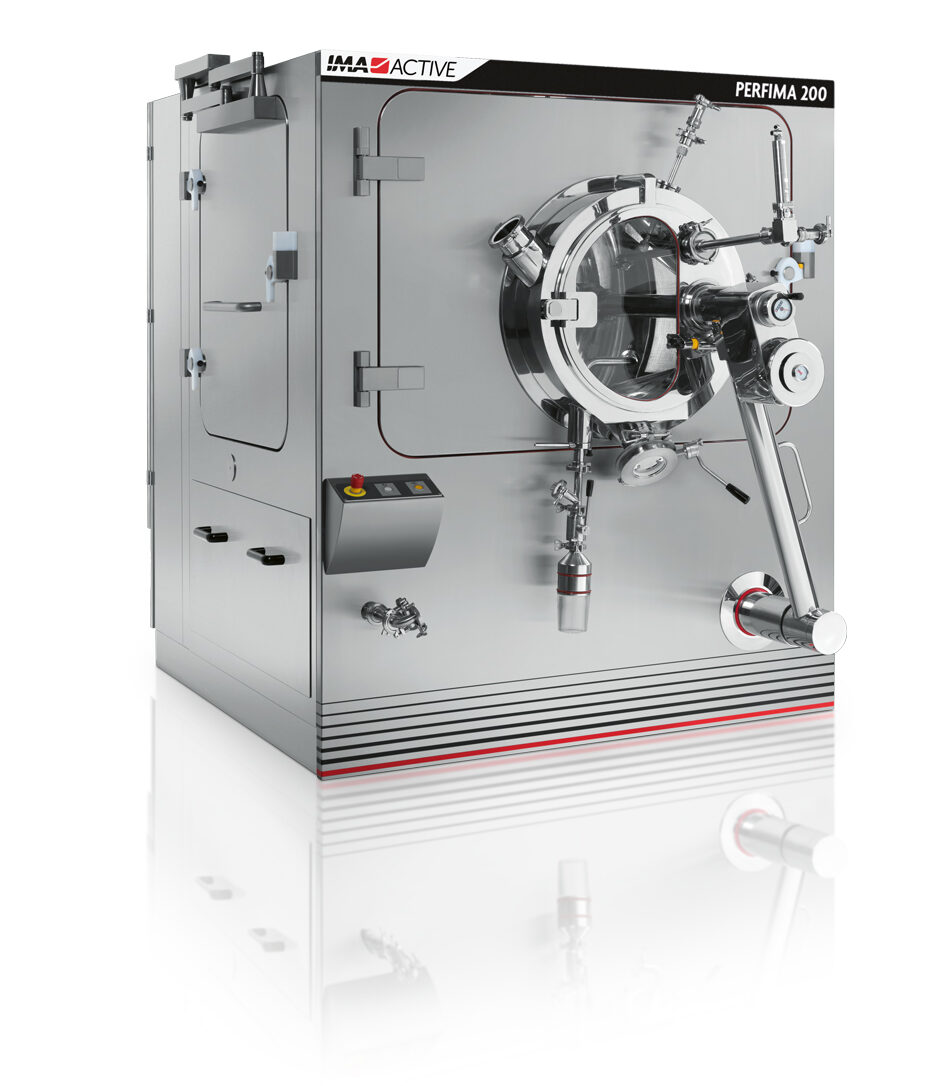
Based on the advantages and disadvantages listed earlier, the selected equipment used for this study is a side-vented pan coater equipped with a wedge wire screen drum-specifically designed for coating of small substrates and multiparticulates such as pellets and/or minitablets. Small wedge wires are fitted into the drum to allow the passage of air during the process.
The equipment maintains the same drum shape, drum geometry and spray system of the standard equipment for tablet coating. The small wedge wires allow cores with a diameter up to 0.8 mm to be processed, maintaining an optimal air flow rate. Among the three different scales used, the coater maintains the same drum shape, mixing baffle geometry, and spray system to guarantee a reproducible process even when scaling up.
The drum design enables high process air volumes, allowing the use of coating parameters similar to those of conventional perforated drum coaters. The pan surface ensures gentle treatment of the cores during coating. Additionally, on the external surface of the drum, the wedge wires provide a semiconical shape enabling easy removal of the coating suspension residue and efficient cleaning.
After setting the coating recipe, main parameters for precise process monitoring are:
Differential pressure monitoring guarantees that the minitablet bed does not clog up the slotted area and remains free flowing. This parameter also ensures that the process runs smoothly without any over-wetting or sticking tendencies.
Cores are always 2.5 mm diameter placebo minitablets tested for uniformity of mass, friability (Roche Friabilator) and crushing strength (TBH 200, Erweka, Germany) and the surface characteristics were observed by Scanning Electron Microscopy (SEM ESEM-FEI Quanta 200). Placebo, supplied by BASF (Germany), is represented by Kollitab DC87L a coprocessed excipient based on lactose monohydrate, crospovidone, Kollicoat® IR and sodium stearyl fumarate. As a coating agent, Acryleze Yellow, purchased from Colorcon (UK) is used at a 20% concentration in water resulting in a theoretical weight gain of up to a 10%. Three coating processes, managed in three different scales respectively, are reported below to show how the process is reproduced in the three different drum capacities.
Table 1 shows in red the most important parameters used to monitor the process all along the spray step: spray line pressure, drum differential pressure, and temperature of cores.
| Parameter | m.u. | Mylab 6 L drum |
Perfima Edge 30 L drum |
Perfima Edge 250 L drum |
| Filling | % | 100 | ||
| Batch size | kg | 4.2 | 21 | 175 |
| Minitablet density | kg/L | 0.7 | ||
| Filling volume | L | 6 | 30 | 250 |
| Pan speed | rpm | 20 | 14 | 9 |
| Peripheral speed | m/s | 0.48 | 0.63 | 0.64 |
| Inlet air q.ty | m3/h | 300 | 1,100 | 4,000 |
| Inlet air T° | °C | 55/60 | 56/64 | 60/70 |
| Cores T° | °C | 32/34 | 32/34 | 32/34 |
| Negative pressure | Pa | -30 | ||
| Average spray rate | g/min | 20 | 90 | 700 |
| Atomization pressure | bar | 0.8 | 1.2 | 1.5 |
| Pattern pressure | bar | 0.8 | 1.0 | 1.2 |
| Gun distance | cm | 10 | 22 | 24 |
| Gun type and number | – | ABC Nano Schlick – 1 |
ABC S35 Schlick – 1 |
ABC S35 Schlick – 4 |
| Nozzle diameter | mm | 1.0 | 1.2 | 1.2 |
| Dispersion to be sprayed | kg | 2.10 | 10.50 | 87.5 |
| Spray line pressure | bar | na | 0.2 | 0.2 |
| Drum differential pressure | Pa | 150 | 320 | 1,200 |
| Spray time | min | 107 | 115 | 125 |
Table 1: Coating parameters and monitoring in all coaters scale.
The absence of oscillation of those parameters ensures a proper trend of the overall process and the opportunity to perform real-time checks for any deviations from normal conditions. Parameters in blue show how the process is transferred all along the three different scales easily: keeping similar peripheral speed, spray rate per kg of cores and increasing the air flow rate accordingly represent the key approach for a proper scale-up.
Minitablets have high potential over standard tablets or pellets due to their flexibility and by virtue of the many advantages already mentioned above. The drum developed as wedge technology presented here and the careful monitoring of the process parameters allow for optimal processing of minitablets: three different processes on three different coater scales are reported in this study and excellent process scalability is observed.
Processes are conducted in all cases smoothly and without particular problems, setting the recipe and achieving a stable process without deviations. Equilibrium of spray process is monitored continuously thanks to the HMI and the established ranges were respected for the entire spray duration. Minitablets weight is achieved and testing for gastroresistance is performed successfully.
The final aspect of individual minitablets is controlled for quality compliance by sampling the process at different stages and at the end, after the cooling stage.
References
[1] Funaro, Mondelli, Passerini, Albertini, Pharmaceutical Technology Drug Delivery, pp. 38-42, 2010.
[2] Priyanka et al., “Journal of Drug Delivery & Therapeutics”, 8(6):382-390, 2018.
[3] Baginski, Bang, Cech, Cembali, Funaro, Mondelli, “39th CRS Annual Meeting”, 2012.
[4] Colorcon, Film Coating for Pediatric Oral Solid Dosage Forms White Paper, http://www.colorcon.com
[5] Herbert, Lieberman, Lachman, Schwartz, “Pharmaceutical Dosage Forms, Tablets”, 2nd Edition, Vol.1, New York and Basel, pp. 387-391.
[6] Oas, Taste Masking – Making Bitter-Tasting APIs Palatable Using the Right Combination of Excipients, “Tablets & Capsules”, IV, 12-18, July 2016.
[7] https://www.peertechzpublications.com/articles/OJC-3-107.php
