
Pharmakeyboard_arrow_rightDetermining maximum sublimation rate for a production lyophilizer: computational modeling and comparison with Ice Slab Tests.
menu

Equipment capability is an important factor in scale up and technology transfer for lyophilized pharmaceutical products. Experimental determination of equipment capability limits, such as the maximum sublimation rate at a given chamber pressure, is time-intensive for production lyophilizers. Here, we present computational fluid dynamics modeling of equipment capability and compare it with experimental data for minimum controllable pressure ice slab sublimation tests in a 23 m2 shelf area freeze dryer. It is found that the vapor flow in the production scale is characterized by turbulent effects at high sublimation rates. For the considered freeze dryer configuration, the onset of turbulence occurs at a sublimation rate of 17 kg/h and leads to an increase in the minimum controllable pressure by 3-4 mTorr for the flow rates up to 40 kg/h. Variations in the shelf and duct orientations as well as the valve stroke distance and their effect on the equipment limit and pressure uniformity are also discussed. The minimum controllable pressure measured experimentally agreed within 5% with computational fluid dynamics results. For high vapor sublimation rates at final stages of ice slab testing, the condenser load affects the product chamber pressure control. Estimate of condenser pressure changes because of ice accumulation has been included.
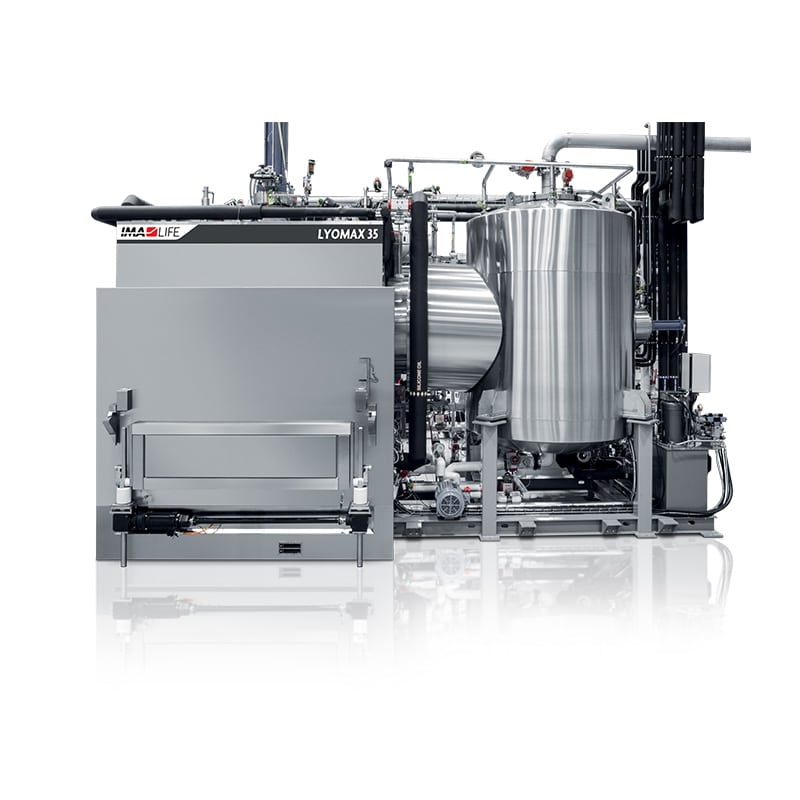
Freeze-drying is widely used in the manufacture of biopharmaceutical products to achieve long-term stability and is a time-and energy-intensive operation. A significant heat input is required to sustain water sublimation, which accounts for about 45% of en-ergy input in freeze-drying, whereas maintaining the vacuum environment takes an additional 26% of energy use.[1] The development of a successful freeze-drying process for a given product requires understanding of capability of a given freeze-drying equipment in terms of maximum sublimation rate [2] or minimum controllable pressure. The shelf temperature and chamber pressure are the 2 main control parameters of the freeze-drying process. The increase in shelf temperature leads to increase in heat transfer rate to the product and a higher vapor sublimation rate. If the sublimed vapor cannot be removed fast enough
by the flow to a lower-pressure region of condenser, the vapor pressure in the chamber will rise. The coupled effects of chamber pressure, shelf temperature, and corresponding sublimation rate and product temperature can be shown as a graph of design space for freeze-drying. The boundaries of design space are defined by the equipment limit curve giving maximum sublimation rate supported by the equipment for a given chamber pressure and the product limit given by the maximum allowable product temperature. The concept of design space is a key element of quality by design [3] approach for pharmaceutical manufacturing. The construction of design space for freeze-drying and the importance to the development of lyophilized parenteral drug products has been previously discussed by Nail and Searles. [4] As the design space contains information pertaining to the product, the process, and the freeze dryer equipment, it is indispensable for design of robust lyophilization processes.[5]
An overall understanding of the freeze dryer operation includes the determination of equipment capability. Changes in freeze dryer may result in a variation of the design space for a given product. The equipment capability limit for a freeze dryer is limited by the choked flow in the connecting duct between the chamber and the condenser, the refrigeration capacity, condenser surface area, and the upper temperature limit for the shelves. The limit on the sublimation rate due to choked flow in the duct was investigated by Searles,[6] where different experiments run on production and pilot scale freeze dryers revealed a loss in chamber pressure control. The loss in chamber pressure control can also be seen in lab scale freeze dryers as investigated by Patel et al.[7,8] In addition, quantifying equipment capability is important for improvement of freeze-drying process performance and designing equipment with better performance, which is one of the current challenges in lyophilization.[9] The experimental setup required for equipment capability testing in large production-scale freeze dryers is expensive and time consuming, and the cost of operation also needs to be considered. Different experimental protocols to obtain the equipment capability can be used. One such known as the minimum controllable pressure test was discussed by Rambhatla et al.,[10] which is the protocol used in the experiments in this article. This protocol can be used as a tool to characterize freeze dryers and for scale-up between laboratory, pilot, and production equipment as previously presented by Tchessalov et al.[11] It is also interesting to observe the nonuniform nature of the heat and mass transfer in the freeze dryer. The edge vial effect, in which the vials near the edges of the shelf dry faster than the vials in the center, is discussed by Pikal et al.[12] In this, the problem of scale-up from the perspective of the edge vial effect is presented. The freeze dryer operation also depends on the load as observed by Patel et al.,[7,8] where product temperatures and surface area are monitored in lab, pilot, and production-scale freeze dryers. The differences in freeze dryers can be observed by looking at the shelf temperature nonuniformity, refrigeration system, and duct resistance, which was investigated by Rambhatla et al.[13]
Computational modeling of the vapor flow in the freeze dryer can give not only the desired design parameters but also reveal the vapor flow patterns, the distribution of pressure as well as the relative concentration of water vapor, and noncondensable gases in the freeze dryer product chamber. Computational fluid dynamics (CFD) computations can explain the pressure variation in the chamber as investigated by Barresi et al.[14] for pilot-scale freeze dryers and confirmed by comparison of CFD and experimental measurements for laboratory scale
by Ganguly et al.[15] Input from CFD can be used to design a process as done by Rasetto et al.[16] Ganguly et al.[17] investigated the amount of radi-ation, convection, and conduction for different vial arrangements and concluded that convection contribution to vial heat transfer can be significant. CFD can also be coupled with 1-D heat transfer equations to generated unsteady-state calculators for process design.[18]
In some cases, particularly in the condenser, the environment is too rarefied for continuum Navier-Stokes equations-based CFD. Thus, a method called the direct simulation Monte Carlo (DSMC) needs to be used. This method was used by Ganguly et al.[18] to investigate production-scale freeze dryers. CFD also makes it easy to investigate the effects of changing geometry on the freeze dryer operations,[19] where comparisons are made for models with and without clean-in-place/sterilize-in-place systems.
In this article, we present computational modeling to obtain the equipment capability limit for a production-scale freeze dryer and verify it by comparison with ice slab sublimation measurements. By changing different design parameters, trends in performance are also established with respect to the chamber pressure and onset of choking.
Download the pdf and read the full white paper
