Personal & Home Carekeyboard_arrow_rightShampoo tablets: a cooperation among IMA, JRS and Laboratorio Cosmopolita.
menu

With the common desire to contribute to broadening sustainable and environmentally attentive gestures, three companies have decided to combine their complementary competences and develop a prototype shampoo tablet.
In 2024, it is estimated that the Beauty and Personal Care market will generate a revenue of US$ 646.20 bn with an expected annual grow rate of 3.33%. Among the different segments, Personal Care is the largest with a market volume of US$ 282.80 bn in 2024.[1] One of the primary factors driving market expansion is the rising consumer awareness concerning their hygiene and appearance.
In this strong-growth context, sustainability plays a key role.
Cosmetics companies are pursuing initiatives to become greener along the entire manufacturing line, from production to final packaging. Topics such as saving water during production, minimising single-use plastic containers in favour of naked products and/or recyclable/biodegradable packaging, and reducing carbon footprints during transportation are not new.
In this scenario, solid cosmetics has indeed become the first answer to the persistent demand from market and consumers: beside soap bars, a wide array of options has been recently appearing on the market such as solid shampoo, solid hair balm, solid lotion and solid cream.
Besides this, consumers are increasingly choosing items that claim to be clean beauty, organic and plant-based. The most recent statistics say that the global revenue of the natural and organic cosmetics market exceeds US$ 12 bn in 2023 and will have increased by 40% in 2028 according to forecasts.[2]
Cosmetics companies therefore are asking for natural, sustainable and biodegradable raw materials as an alternative to synthetics and liquid plastics.
With the common desire to contribute to broadening sustainable and environmentally attentive gestures, three companies have decided to combine their complementary competences and develop a prototype shampoo tablet.
The aim is to gain experience regarding the feasibility of this type of product and be ready to support cosmetics companies wanting to engage in this new field.
| LABORATORIO COSMOPOLITA | JRS | IMA Active |
| Formulators with substantial technical expertise, in-depth knowledge of the market and open to the world. Evaluate raw material application potential, realise prototype formulation, up until creation of finished products. | Leading manufacturer of excipients, including functional fillers and binders, stabilisers and disintegrants. Focus on Personal Care through waterless cosmetics and rheology modifiers. JRS also offers scrubs and sensory enhancers for microplastic replacement. All are natural, sustainable, biodegradable and made from renewable resources. | Division of the IMA Group specialised in processing equipment for solid dosage forms, like powders, granules and tablets. At the IMA Active Competence Center, process experts ensure methodical and quick achievement of satisfactory results. |
This article illustrates each step of this successful cooperation.
The trials have been carried out at the IMA Active Competence Center on R&D scale equipment. Several small batches were thereby processed, saving raw materials while adjusting formula and process.
The Roto cube high shear mixer granulator was used for the dry mixing of powdery ingredients, to add liquid to the blend and also to dry wet granules.
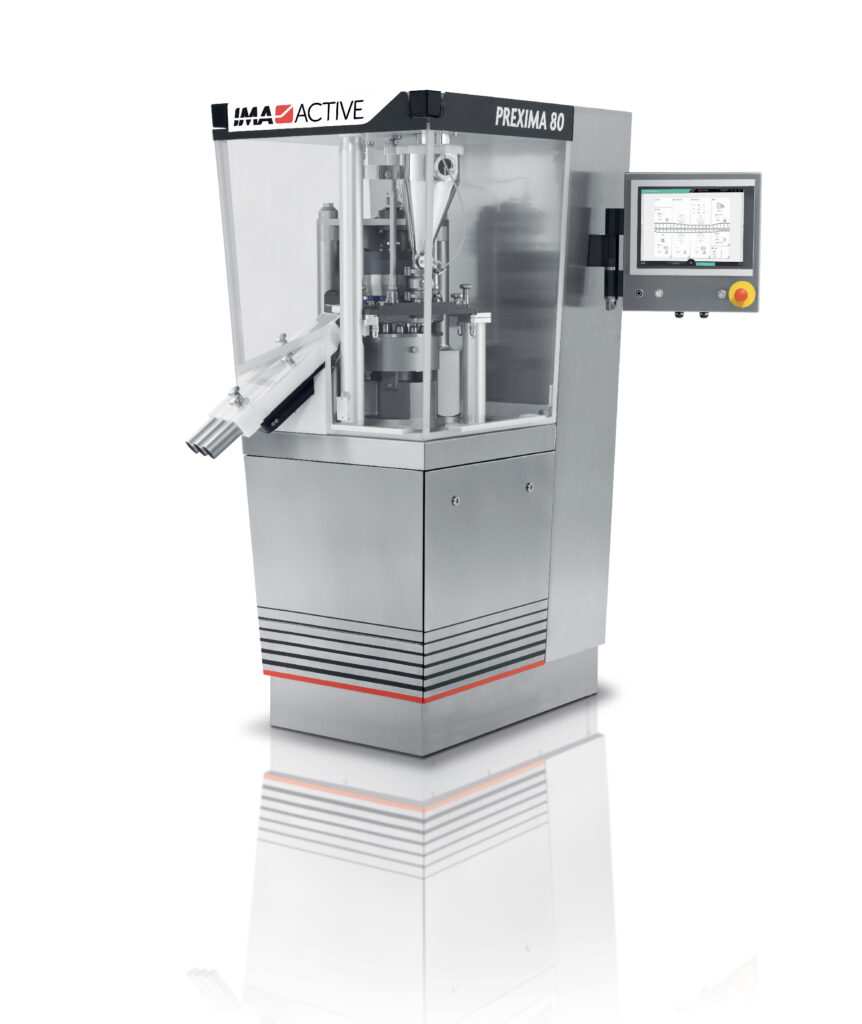
For the compression of the blends, a Prexima 80 tablet press was equipped with four compression stations for the production of diameter 13 mm tablets. Ingredients were provided by JRS and the formulation created and improved with the support of Laboratorio Cosmopolita.
After first-round trials, the formulation as shown in Table 1 was defined and shampoo tablet samples were subjected to several blind tests in JRS.
Feedback was collected and used for formula and product improvement.
| Category Why was it selected? |
Compounds (n) | INCI | Percentages (%) |
| 2 in 1 filler/binder Compacting ingredient, with exceptional flowability, allows quick disintegration |
VIVAPUR® CS 130 FM 100% natural origin |
Microcrystalline |
39.0 |
| Surfactant Cleaning properties | Lathanol LAL Coarse | Sodium Lauryl Sulfoacetate |
16.2 |
| Rheology modifier Swelling powder, turning into gel immediately when in contact with water |
VIVASTAR® CS |
Sodium carboxymethyl starch | 1.0 |
|
Conditioner |
Betaine |
Betaine | 2.5 |
| Disintegrant For short tablet disintegration time |
VITACEL® CS 300 DI |
Cellulose | 6.8 |
| Lubricant Improve flowability, while preventing product sticking to machine parts |
Magnesium stearate |
Magnesium stearate | 1.0 |
Table 1: shampoo formula after first-round trials.
Accepted for scalp scrub or a 2-in-1 shampoo with peeling property, but not suitable for a normal shampoo. Two ingredients were found to be potentially responsible for that effect:
The request was to improve the disintegration time and the sensoriality of the activated tablet. This was achieved by increasing the quantity of the modified starch VIVASTAR® CS instant powder and
VIVAPUR® CS 130 FM, the microcrystalline cellulose. The new tablet was able to become a gel just a few seconds after being in contact with water, with a pleasant soft touch and good foaming qualities as well.
In order to extend the properties of the shampoo, making it beneficial also for scalp care, the improved formula was enriched with active ingredients, both in powder and liquid form.
| Compounds (n) | INCI | Percentages(%) |
| VIVAPUR® CS 130 FM | Microcrystalline cellulose | 57.6 |
| Lathanol LAL Coarse | Sodium lauryl sulfoacetate | 16.0 |
| VIVASTAR® CS Instant Powder | Sodium carboxymethyl starch | 10.0 |
| Betaine | Betaine | 2.5 |
| Aloe vera (powder) | Aloe barbadensis leaf extract | 0.1 |
| Niacinamide (powder) | Niacinamide | 1.0 |
| Parfum “Aqua” (liquid) | Parfum | 0.3 |
| Argan oil (liquid) | Argania spinosa kernel oi | 0.5 |
| VITACEL® CS 50 DI | Cellulose | 10.0 |
| Magnesium stearate | Magnesium stearate | 2.0 |
Table 2: shampoo formula improved and enriched with active ingredients.
Despite the low amount, the Roto cube impeller shape, the geometry of the container as well as the right nozzle are key elements for the homogeneous distribution of the ingredients in the blend. Furthermore, the preparation of the formula takes just a few minutes.
Before compression, IMA process experts characterised the blend; they expected challenges due to the addition of the liquid phase.
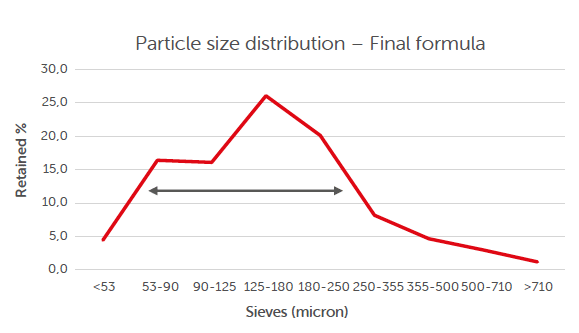
Graph 1: particle size distribution of final shampoo formula.
The final formula showed a bimodal trend in terms of particle size distribution (Graph 1), with quite a wide particle size range. This is a clear indication that the blend may have poor flowability. This is confirmed by the Carr Index: it got worse after adding the liquid phase, from 23 to 26. Also very interesting to note is the bulk and tapped density, which decreased by about 0.1 g/ml. It was now time to investigate not only process parameters on the tablet press, but also the machine configuration. In particular, the standard die feeder and paddles were replaced with more suitable ones for a blend with those specific characteristics.
With the final adjustments, the process became consistent, reliable and reproducible. Prexima 80 runs at 13,200 tablets/hour with a relative standard deviation of 1-1.5% on tablet weight and of 9% on tablet hardness.
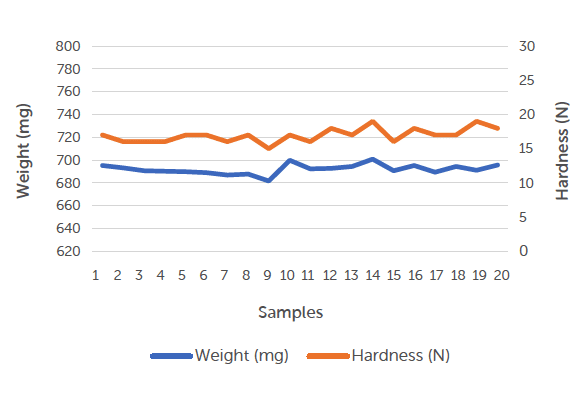
Graph 2: weight and hardness of collected samples of shampoo tablets.
These low values, in line with the accuracy typically required by the pharmaceutical sector, ensure benefits for cosmetics companies as well. Looking at several collected samples (Graph 2), it is possible to appreciate how every tablet is almost identical to the other.
For a consumer, this means the same experience and repeatable performance at every usage. In conclusion, the cooperation among IMA, JRS and Laboratorio Cosmopolita, thanks to their complementary expertise and competences, led to the successful development of a prototype shampoo tablet, demonstrating the feasibility of process and product. Not to forget that the formula also has a very high Natural Origin Content of 96.8 %
References
[1] https://www.statista.com/outlook/cmo/beauty-personal-care/worldwide [2] https://www.statista.com/forecasts/1264932/worldwide-revenue-natural-organic-cosmetics-market