
Pharmakeyboard_arrow_rightWhite Papers / Natural coating formulations: IMA is ready for the latest trend.
menu

 Author Author
Caterina Funaro, Process R&D Laboratory Manager at IMA Active |
Greater awareness and increasing popularity among consumers to select drugs or food supplements exhibiting a clean label is a trend that producers are unable to ignore.
The demand for authentic products and total transparency is affecting the entire industry, and IMA is well prepared to cater for this scenario as it matures.
2. The Clean Label concept
So what is a clean label and what does it certify?
Starting with dietary supplements, moving through nutritionals and on to cosmetic products, the clean label concept affirms the absence of any artificial or synthetic excipients.
This begins with raw material suppliers and continues along the entire production process — right up to the final coating in the case of coated tablets.
Many raw material suppliers are now members of the Clean Label Alliance, an association helping companies producing dietary supplements by providing top-of-the-line resources and solutions to efficiently produce clean label products.
Driven by consumers, the clean label trend is gaining momentum. The market is moving away from ingredients that are not natural.
One prime example is colouring agents, which should no longer make use of titanium dioxide (TiO₂).
Formulating an effective coating without TiO₂ can be extremely challenging. While TiO₂ poses little or no adverse health risks in lotions and creams, it is considered a potential carcinogen when inhaled in powder form (International Agency for Research on Cancer).
The tablet-coating process relies heavily on TiO₂ for its whitening and opacifying properties. Avoiding its use in aesthetic formulations makes effective tablet coverage more difficult.
Many raw material suppliers are adapting their ready-to-use formulations to avoid TiO₂.
The best coverage is achieved by correctly managing key formulation elements:
When using TiO₂-free formulations, an increase in weight is normally advisable to improve core appearance and light stability. This gain ranges from 4–7%, depending on the cores and the need to contrast yellowing.
There are no concrete alternatives to TiO₂ with identical opacifying properties. It’s about finding the best combination of ingredients to achieve a coating finish as close as possible to the titanium-based standard.
Many ready-to-use coating formulations are available on the market, mainly HPMC-based, and offered as clear, white or pigmented systems.
The European Food Safety Authority (EFSA) updated its assessment on the safety of TiO₂ as a food additive in 2021, concluding that genotoxicity concerns cannot be excluded.
As a result, the European Commission issued Regulation (EU) 2022/63, banning the use of TiO₂ as a food additive (E171). This particularly affects the food and dietary supplement industry.
Although the pharmaceutical sector is not yet impacted, scientists are already working to reformulate coatings using TiO₂ alternatives — and in some cases, even talc.
To anticipate this trend, the IMA Active Competence Center has launched an initiative to gain extensive experience with new excipients and be ready with the best technical solutions.
This aligns with the group’s internal sustainability policy, the IMA Zero project, which aims to minimise the environmental impact of industrial manufacturing — from reduced power needs and eco-friendly packaging to minimal water consumption.
Calcium carbonate and sugars such as isomalt or rice starch are being combined to create equivalent opacity and good light stability.
| Supplier | Product* |
| Seppic | Sepifilm TF |
| Colorcon | Nutrafinish TF |
| Sensient | Spectrablend TFN |
| Biogrund | Aquapolish TiO2 free |
| JRS | Vivacoat Free Nutra |
| Ashland | Aquarius TF Nutra |
*all references in sitography
Table 1: a selection of popular TF coatings available on the market.
To complete this review, a table indicating the coating parameter ranges suggested for the above-mentioned products is provided for both pilot and production-scale coaters. General ranges are given to cover all supplier proposals.
Raw material suppliers have worked to mimic the opacifying effect of TiO₂. The most frequently cited alternative in literature is calcium carbonate, used at specific particle sizes to offer strong opacity and a white finish.
In conclusion, talc is also under examination for potential health risks. Pharmaceutical companies are already acting to replace it with safe excipients offering similar anti-tacking properties.
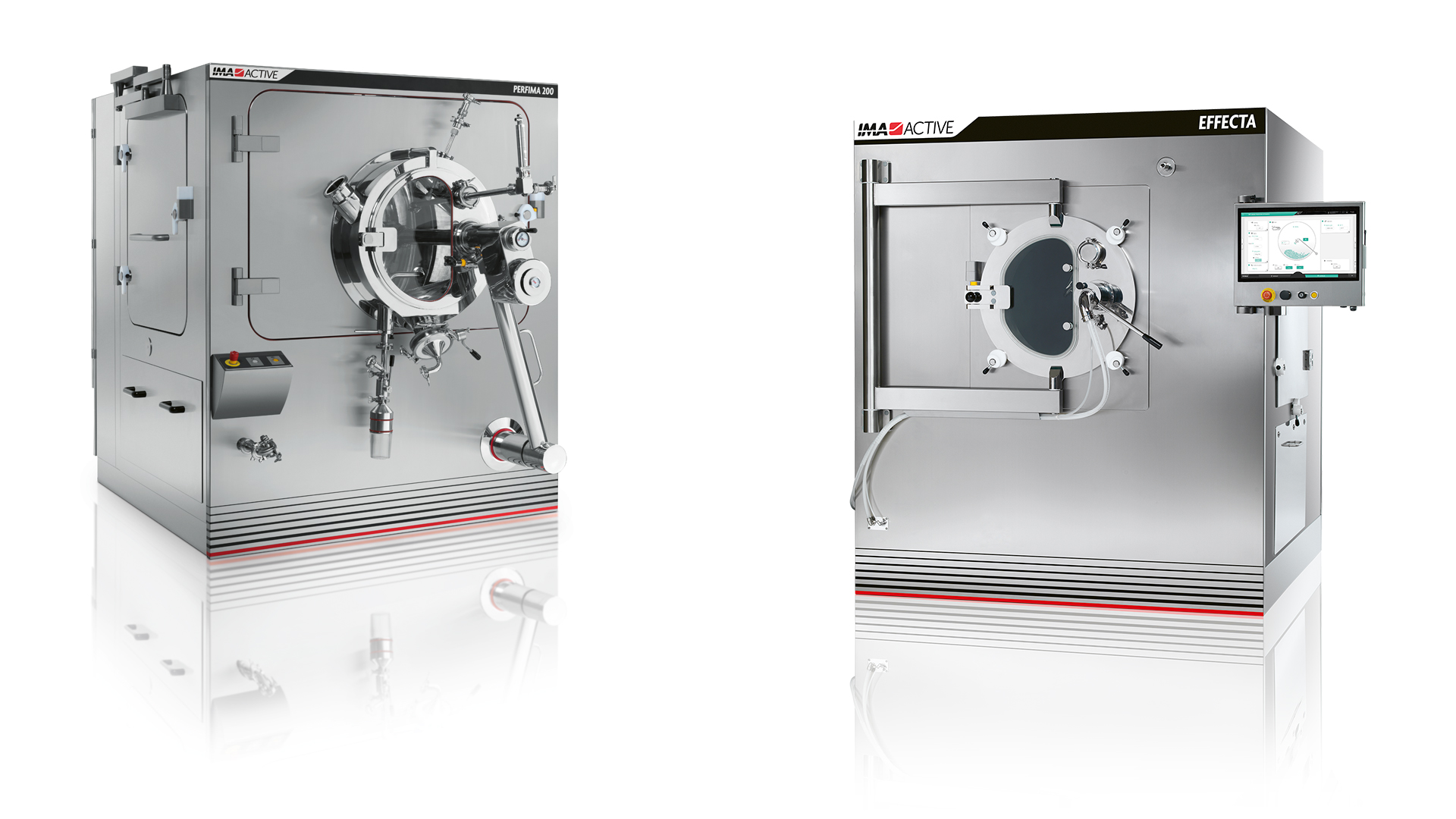
| Pan Type | m.u. | Perfima Lab | Perfima/Effecta 200 |
| Pan Volume | L | 30 | 250 |
| Pan Filling | % | 100 | 100 |
| Pan Load | kg | 22 | 180 |
| Weight increase | % | 6 | |
| Solvent used | – | water | |
| Solids concentration | % | 18 | |
| Gun type | – | Schlick ABC | |
| Gun number | – | 1 | 4 |
| Nozzle diameter | mm | 1.2 | 1.2 |
| Gun distance | – | 22 | 25 |
| Atomisation pressure | bar | 1.5-1.8 | 2.4-2.8 |
| Pattern pressure | bar | 1.5-2 | 2-2.5 |
| Pan speed | rpm | 14 | 8 |
| Inlet air flow rate | m3/h | 600 | 3,800 |
| Inlet air T° | °C | 55-58 | 60-62 |
| Target cores T° | °C | 43-45 | 43-45 |
| Spray rate | g/min | 60-90 | 450-550 |
| Total suspension to be sprayed | min | 6,600 | 54,000 |
| Estimated spray time | min | 80-90 | 90-110 |
| Note: the 6% weight gain is targeted to simulate a worst-case scenario (dark or coloured tablets) but for white tablets, a lower increase could also be valid. | |||
Table 2: parameter ranges for coating processes with TF coating formulations.
References
[1] https://www.pharmaexcipients.com/titanium-dioxide-tio2/
[2] https://www.european-coatings.com/news/raw-materials/titanium-dioxide-ruling-opacity-out-of-existence/
[3] https://www.colorcon.com/markets/nutritional/coatings/nutrafinish-titanium-dioxide-free/download/3672/5090/34.
[4] https://www.colorcon.com/kr/colorcon-insights/5433-tio2-eu-regulations-and-pharmaceuticals-titanium-dioxide.
[5] https://www.sigmaaldrich.com/deepweb/assets/sigmaaldrich/product/documents/128/709/parteck-ta-whitepaper-wp12274en-ms.pdf.
[6] https://www.seppic.com/en/titanium-dioxide-free-formulation.
[7] https://www.colorcon.com/markets/nutritional/coatings/nutrafinish-titanium-dioxide-free.
[8] https://www.sensientpharma.com/product/tio2-free-coating/.
[9] https://www.biogrund.com/tio2/?lang=en.
[10] https://www.jrspharma.com/pharma_en/products/coatings/vivacoat-free.php.
[11] https://www.ashland.com/industries/healthwellnessandnutraceuticals/product-solutions/aquarius-nutra-tf-titanium-free-film-coating-systems.