
Coffeekeyboard_arrow_right"Materiaux D'emballage durables: defis et opportunités pour les torrefactions. Comment les adopter?", the conference moderated by IMA at the Paris Coffee Show 2024
menu

Innovation and Sustainability at the Paris Coffee Show: The Coffee Packaging Roundtable Between Challenges and Opportunities
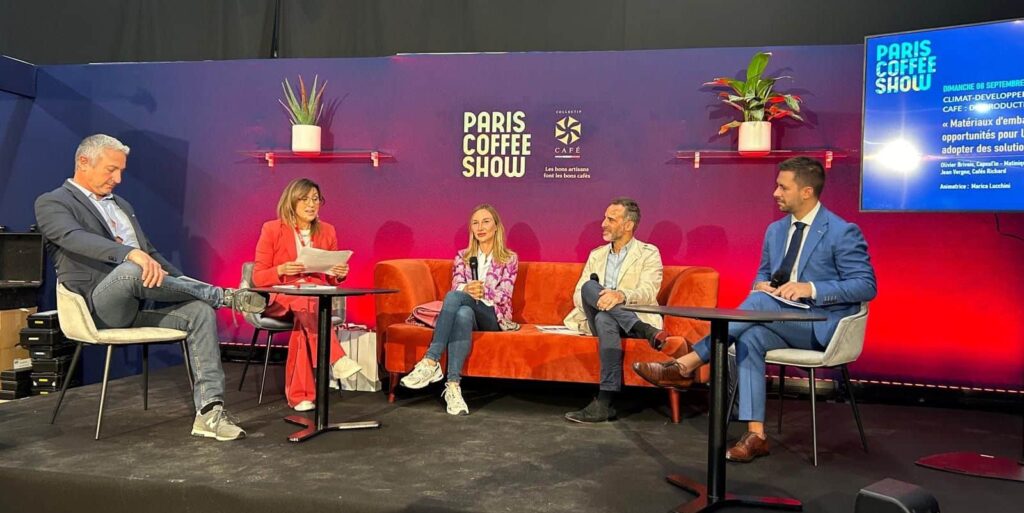
On September 8, 2024, during the Paris Coffee Show, an important meeting for the coffee sector took place a roundtable moderated by Ms. Marica Lucchini, Business Development Manager at IMA Coffee. The session focused on a critical topic for the future: the sustainability of coffee packaging.
This event brought together industry leaders to discuss environmental challenges, technological innovations, and emerging regulations in the field of packaging, with a particular focus on circularity and end-of-life management of materials.
Ms. Marica Lucchini opened the session with a reflection on the importance of sustainability: “During this session, we will connect some of the largest producers of packaging materials with a representative from one of France’s largest roasteries to discuss trends in coffee packaging materials and solutions to reduce their environmental impact, particularly focusing on the end-of-life phase of materials.”
The roundtable speakers included:
Mr. Olivier Brivois, Co-founder and Director of Research and Development at Capsul’in
Ms. Matinique Vyvey, Export Manager at AluSense
Mr. Dionysis Chatzikamaris, Account Manager at Hatzopoulos
Mr. Jean Vergne, Production Director at Cafés Richard
A key topic of discussion was the regulatory approach to sustainability. Mr. Dionysis Chatzikamaris from Hatzopoulos shared significant updates on European laws set to take effect in the coming years: “The future is already here. By 2030, all packaging must be designed for recycling. This is both a challenge and an opportunity to completely rethink how we design packaging.”
The regulations mandate that 55% of plastics must be industrially recycled, and many materials will need to meet strict criteria for recycling or composting. Furthermore, food packaging will be required to contain up to 25% recycled materials by 2040.
These new laws push the industry to think beyond the present, designing packaging that respects the lifecycle of materials, thus minimizing environmental impact. Mr. Chatzikamaris emphasized the importance of creating recyclable and compostable packaging to meet future challenges.
The challenges do not stop with regulations. The market is rapidly evolving, and demand for sustainable packaging is growing significantly. Mr. Olivier Brivois highlighted the difficulties of developing high-performance yet eco-friendly solutions. Capsul’in was an early innovator, launching certified compostable capsules as early as 2015.
Ms. Matinique Vyvey of AluSense brought a clear and innovative perspective on sustainability in the coffee capsule sector, focusing on the key role of aluminum and her company’s new compostable solutions. In 2016, AluSense became the first company in the world to launch a recyclable aluminum capsule compatible with Nespresso. “Aluminum is inherently sustainable. Its ability to be infinitely recycled without losing quality makes it an excellent choice for addressing environmental challenges. We firmly believe that the key to long-term sustainability lies in using materials that can have a second life.”
Ms. Vyvey stressed the importance of going beyond material recyclability to design truly compostable solutions, creating a closed loop that significantly reduces ecological impact. “We didn’t stop at aluminum. In 2024, we launched a home-compostable capsule, Biosense, representing another important step toward the circular economy. Compostability is an innovative solution that allows consumers to dispose of capsules even more responsibly.”
Mr. Jean Vergne, Production Director at Cafés Richard, emphasized the importance of an integrated approach to sustainability: “We are committed to CSR projects and improving our packaging. Cafés Richard was the first French roaster to obtain the ‘Engagé RSE’ certification in 2022, and we actively participate in flexible packaging recycling initiatives.”
While legislation and market demands accelerate change, companies also face technical challenges. Mr. Jean Vergne spoke of the difficult but enthusiastic transition to sustainable materials, tackling challenges with determination: “The introduction of compostable and recyclable materials requires extensive teamwork involving all company departments. Our goal is always to preserve coffee freshness while ensuring the packaging is as eco-friendly as possible.” This journey demands sacrifices but also a clear vision of the future: a future where every company plays a crucial role in reducing ecological impact.
Another key point raised by Ms. Matinique Vyvey of AluSense was the balance between innovation, costs, and performance. AluSense met the challenge of creating high-performing capsules that meet stringent standards for preserving coffee aroma without compromising sustainability. “We had to balance several factors, such as material costs, oxygen barriers, and the level of coffee aroma protection. Our goal was not to sacrifice quality for sustainability. Every step we take is designed to unite these aspects.”
A recurring theme was the importance of finding a balance between sustainability, quality, and price. Mr. Olivier Brivois of Capsul’in stated: “The main obstacle is finding solutions that are truly sustainable without compromising product quality. Adopting compostable and 100% recyclable capsules is part of our commitment to a low-impact future.” Additionally, he announced the imminent launch of a new capsule that is 100% bio-sourced, compostable, and recyclable.
Mr. Brivois highlighted the need to educate consumers about new eco-friendly solutions: “Even if the product is innovative, it is essential for consumers to know how to recycle it correctly. Sustainability doesn’t depend solely on what we do at the production level but also on how we inform and train the public to adopt responsible behavior.”
Packaging circularity is a fundamental concept for the future of packaging. Mr. Dionysis Chatzikamaris emphasized the need to develop packaging that not only can be recycled but is designed to be part of a continuous cycle, minimizing reliance on virgin raw materials. “Our commitment is to design packaging that can be reused without compromising coffee quality and without generating waste. This is a paradigm shift: no longer a linear model but a closed loop where materials are not discarded but reintegrated into a new production process.”
This goal is one that packaging companies like Hatzopoulos aim to achieve through the use of recycled or bio-based materials and technological innovations that optimize recycling. Furthermore, it was emphasized that cooperation between companies and advocates of circularity is essential to realize this radical change.
Mr. Jean Vergne highlighted how Cafés Richard chose to use eco-responsible packaging for all its products, responding to the growing demand for environmentally friendly products. “We are pleased to see that consumers are increasingly aware, which motivates us to do better every day.” In response to this trend, many companies are seeking to educate consumers through awareness campaigns, showcasing the positive aspects of more responsible choices. Additionally, surprising data emerged: 72% of consumers claim they are willing to pay more for a product with eco-friendly packaging.
The roundtable at the Paris Coffee Show concluded with a strong declaration of commitment to a more sustainable future, expressed by Ms. Marica Lucchini. In closing the session, she emphasized that the discussion was not just a moment of exchange but an opportunity to unite the coffee sector around a common goal: responsible innovation. Ms. Lucchini reaffirmed the importance of considering sustainability not as a mere requirement but as a mission demanding concrete commitment from all companies in the supply chain. “IMA Coffee is not limited to being a technology provider; our goal is to become a partner in creating sustainable solutions,” she concluded, highlighting the need to continue collaborating and innovating to make sustainability a tangible reality at every stage of the production process.